Overview
Agent communication protocols are quickly becoming core infrastructure for LLM systems that call tools, collaborate with other agents, and operate across heterogeneous environments. This paper argues that the ecosystem has advanced rapidly on transport and structure, but still lacks strong protocol-level support for meaning alignment. It also provides a practical view of when different protocols are the right deployment choice.
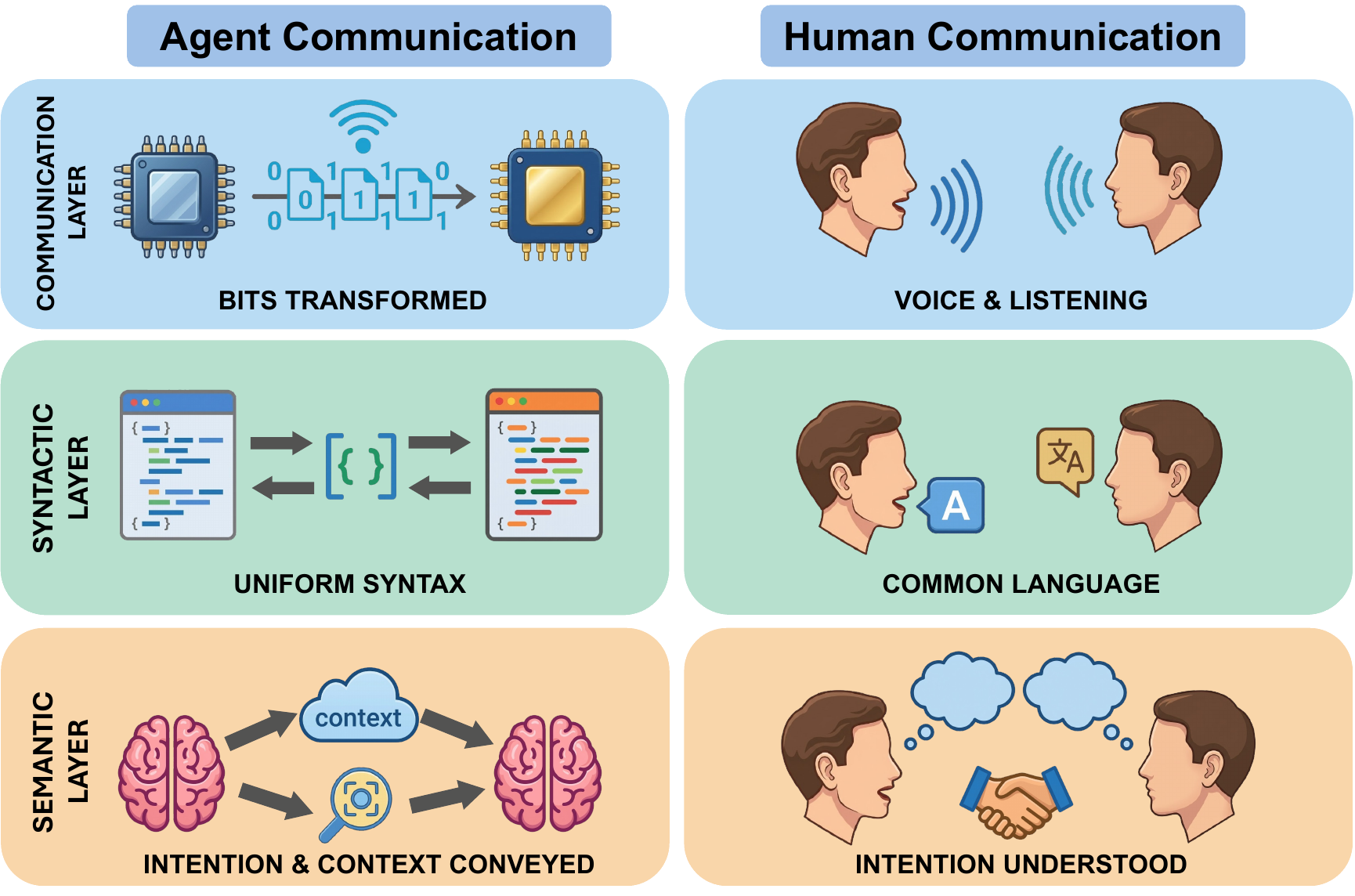
The central claim of the paper is simple: agents should not only exchange messages correctly—they should also have protocol support for understanding them consistently.
What the paper contributes
1. A new lens
The paper introduces a human-inspired framework that maps agent communication onto communication, syntactic, and semantic layers.
2. Comparative analysis
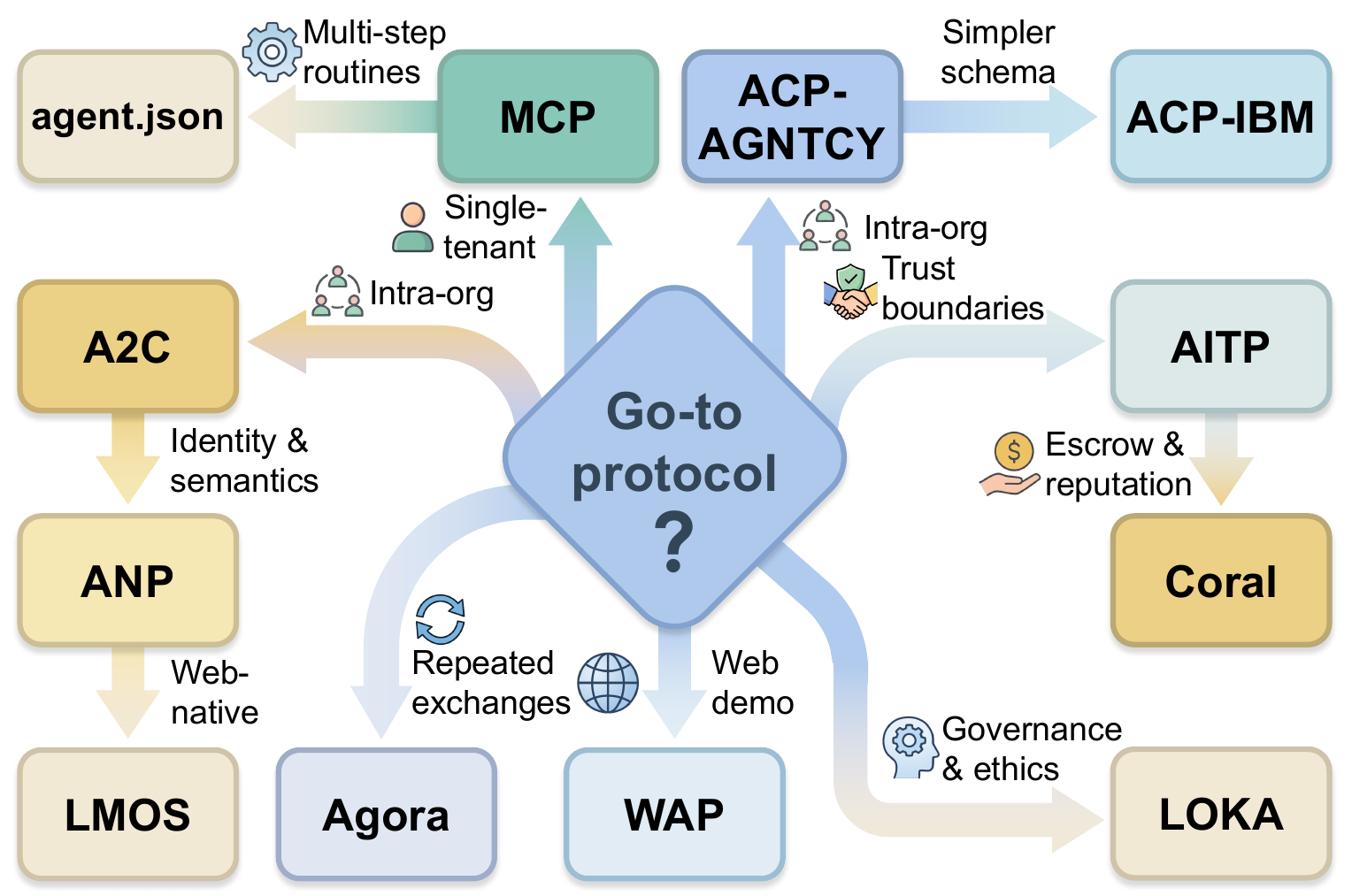
It comparatively analyzes 18 representative protocols spanning tool-use interfaces, agent orchestration standards, decentralized agent networks, and trust-aware systems.
3. A practical diagnosis
It identifies a recurring semantic gap: many protocols standardize delivery and structure, but leave clarification, context alignment, and verification to prompts or wrappers.
Why the semantic layer matters
What current protocols do well
- Reliable transport
- Streaming and session mechanics
- Schema definition and validation
- Lifecycle and error handling
What often remains missing
- Clarification when intent is ambiguous
- Shared contextual grounding across agents
- Verification that interpreted meaning matches intended meaning
- Protocol-native repair instead of ad hoc prompting
Protocols analyzed in the paper
The paper spans a wide slice of the emerging agent communication ecosystem, from single-tenant tool protocols to cross-organizational and decentralized designs.
Practical angle
Deployment-oriented guidance
The paper also turns its analysis into a deployment-oriented selection workflow, helping practitioners choose a protocol based on settings such as single-tenant tool use, intra-organizational orchestration, open-web delegation, repeated interactions, trust-boundary transactions, or governance requirements.
Design message
The recommendation is to choose the simplest protocol whose native guarantees reduce the relevant communication, schema, and meaning drift—without adding unnecessary complexity.
Abstract
Citation
@article{yuan2026beyondmessagepassing,
  title   = {Beyond Message Passing: A Semantic View of Agent Communication Protocols},
  author  = {Yuan, Dun and Lyu, Fuyuan and Yuan, Ye and Zhang, Weixu and He, Bowei and Geng, Jiayi and Du, Linfeng and Sun, Zipeng and Chen, Yankai and Han, Changjiang and Kang, Jikun and Chen, Alex and Wu, Haolun and Liu, Xue},
  year    = {2026},
  journal = {Preprint}
}